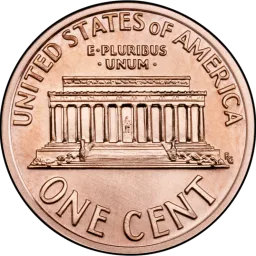
1972 values by mint mark
A coin with no mint mark was struck in Philadelphia.
| Coin | Mint | Mintage | Value |
|---|---|---|---|
| 1972 | Philadelphia, no letter | 2,933,255,000 | Face value |
| 1972-D | Denver | 2,665,071,400 | Face value |
| 1972-S | San Francisco | 376,939,108 | Face value |
Not sure which one you have? Scan it, and Coin Finder reads the mint mark for you.
Scan your coinIs yours the 1972 doubled die (front)?
1972 doubled die (front)
$300 or more
The stamp (die) for the front had a doubled image. The date, LIBERTY and IN GOD WE TRUST are strongly doubled.
Listed for 1972.
The app shows this checklist for the coin you scan.
1972 cents were made in huge numbers, and a worn one is just a cent. The doubled die is also the coin people most often think they have when they don't, so check it carefully.
How to tell
Check the coin in this order:
- Date and mint mark. The mint mark tells you which one you hold: no mint mark, a D, or an S. The doubled die is listed only under the 1972 with no mint mark.
- Look at the front. Hold the coin under a bright light with a magnifying glass. The doubled die shows strong doubling on the date, on LIBERTY and on IN GOD WE TRUST.
- Compare all three places. On the real variety the doubling is plain on all of them. Doubling on one letter only is not enough.
- Judge how strong it is. On the real coin the doubling is strong. If you need to tilt the coin and squint to see it, it is probably not the variety.
The 1972 doubled die
The stamp (die) used to strike the front of this coin had a doubled image. Every coin struck from it carries the doubling on the date, LIBERTY and IN GOD WE TRUST. A genuine one is worth $300 or more. Its condition decides how much more.
Weaker look-alikes
Many 1972 cents show a little doubling, a slight shadow or a thickened edge on a letter. That is common on cents and is not the variety. A real doubled die has clear, separate doubling you can see without much effort. If you think you have one, a professional grading service such as PCGS or NGC can examine it, and dealers can tell you what they would pay.
The common 1972 cents
The plain 1972, the 1972-D and the 1972-S are all common and worth face value in ordinary condition. A D or an S does not make one rarer.
They are mostly copper, as cents were up to 1982, which is why the metal is worth a little. Newer cents are copper-plated zinc.
Condition
Wear lowers value. A coin that has been in pockets and registers for decades loses detail on the date and lettering, and that includes the doubling you are looking for. Do not clean the coin. Rubbing, polishing or dipping it lowers its value, and a cleaned coin is hard to sell to a collector.
Hold the coin by its edges and keep it in a soft holder until someone has looked at it.
Other cents worth a look
The doubled date and lettering also turns up on a 1969-S cent, so see the 1969 guide. Other Lincoln Memorial cents with valuable varieties are in the 1982 guide and the 1992 guide. For the whole design, read Lincoln Memorial penny values or Lincoln cent values.
Metal value
- $0.04 for 95% copper, 5% zinc (3.11 g)
Questions
Is a 1972 penny worth anything?
Most are worth face value. A normal 1972, 1972-D or 1972-S is a common coin. Only the doubled die is worth much more.
How do I know if my 1972 penny is a doubled die?
Look at the date, LIBERTY and IN GOD WE TRUST on the front. All three should show strong doubling. Slight doubling on one spot is common and does not count.
Does a mint mark change the value?
Not for the common coins, which are all worth face value. The doubled die is a 1972 cent with no mint mark, so a D or an S is not that variety.
Should I get my coin graded?
If it shows strong doubling in all three places, a professional grading service can examine it. If it shows only slight doubling, it is very likely an ordinary cent and not worth the fee.
More Lincoln cents to check
Check the rest of your change
Over 1,100 US and UK coins by year and mint mark, each value with its source and the date it was checked.
