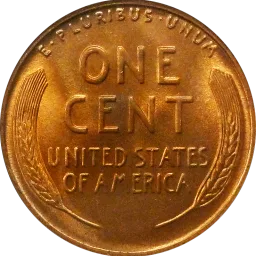
Every design
| Design | Mintage | Value | Rarity |
|---|---|---|---|
| Lincoln wheat penny | 140 dates and mint marks | Up to $100,000 | Has key dates |
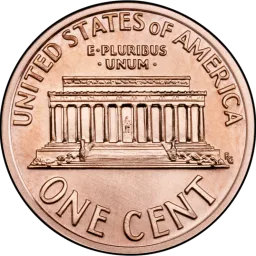
| Lincoln Memorial penny | 104 dates and mint marks | Up to $25,000 | |
| Lincoln Bicentennial Birthplace penny | 284,800,000 | Face value | Common |
| Lincoln Bicentennial Birthplace penny | 350,000,000 | Face value | Common |
| Lincoln Bicentennial Formative Years penny | 376,000,000 | Face value | Common |
| Lincoln Bicentennial Formative Years penny | 363,600,000 | Face value | Common |
| Lincoln Bicentennial Presidency penny | 129,600,000 | Face value | Common |
| Lincoln Bicentennial Presidency penny | 198,000,000 | Face value | Common |
| Lincoln Bicentennial Professional Life penny | 316,000,000 | Face value | Common |
| Lincoln Bicentennial Professional Life penny | 336,000,000 | Face value | Common |
| Lincoln Shield penny | 32 dates and mint marks | Face value |
A few errors on later pennies are worth far more than any date, and each has its own tell.
How to tell
- Read the date. Pennies dated 1909 to 1958 have two wheat ears on the back. Pennies dated 1959 to 2008 show the Lincoln Memorial. The 2009 pennies have four special designs, and 2010 on has the Union Shield.
- Find the mint mark. A mint mark is a small letter showing where the coin was made. S is San Francisco, D is Denver, and no mark means Philadelphia. A 1909-S is a very different coin from a 1909 with no mint mark.
- Look at the design. On a 1909 cent, check for the initials VDB, which stand for the designer, Victor D. Brenner.
- Judge the wear. A heavily worn coin sits at the low end of its range.
Wheat cents, 1909 to 1958
Most wheat cents are common: a 1940 is worth $0.03 to $0.15. The money is in the early years and the S and D mints.
- 1909-S VDB is the hardest date of the series to find. Only 484,000 were made, and it is worth $563 to $977.
- 1909-S without the initials is worth $64 to $117.
- 1909 VDB with no mint mark is far more common, and worth $4.01 to $10.
- 1914-D is another low-mintage date, worth $69 to $631.
- 1910-S is worth $6.83 to $40, and 1911-D is worth $3.17 to $46. Both are worth more than face in any condition.
- 1922-D is worth $8 to $39. A 1922 cent with no D mint mark is worth much more, $255 to $872.
Three errors are worth checking for. A 1943 cent struck on a copper blank is worth $100,000 or more. A 1944 cent struck on a steel blank is worth $75,000 or more. A 1955 cent with a doubled die on the front is worth $858 to $2,464.
See the guides to the 1909, 1914, 1922, 1931, 1943 and 1955 cents, or the full Lincoln wheat penny list.
Memorial cents, 1959 to 2008
Almost every Memorial cent is worth face value. The ones to look for are varieties, and each one has a tell:
- 1960-D small date over large date: the date was punched into the stamp twice, a small date over a large one. It is worth $200 to $500 uncirculated.
- 1960 small date: the tops of the 6 and 0 are level with the 1 and 9. It is worth $3 to $7 uncirculated.
- 1969-S doubled die (front): the date, LIBERTY and IN GOD WE TRUST are strongly doubled. It is very rare and worth $25,000 or more. Read the 1969 guide before you pay for one.
- 1970-S small date: the top of the 7 is level with the 9 and 0. It is worth $60 uncirculated.
- 1972 doubled die (front): the same strong doubling on the date, LIBERTY and IN GOD WE TRUST. It is worth $300 or more. See the 1972 guide.
- 1982-D copper small date: Denver small-date cents of 1982 should be copper-plated zinc, so a heavier copper one is the error. It is very rare and worth $10,000 or more. The 1982 guide has more.
- 1983 doubled die (back): ONE CENT, E PLURIBUS UNUM and UNITED STATES OF AMERICA are doubled. It is worth $400 uncirculated. See the 1983 guide.
The 1992, 1995 and 1999 guides cover more varieties. The full list is in the Lincoln Memorial penny guide.
Bicentennial and Shield cents, 2009 to 2025
The 2009 cents had four reverse designs: Birthplace, Formative Years, Presidency and Professional Life. Doubled die versions have been found on the Formative Years design; otherwise these and almost all Shield cents from 2010 on are worth face value. The last everyday cents struck at Philadelphia and Denver in 2025 have a small omega mark. They were sold at auction in sets with a gold cent and were not released into change, so you will not find one in a jar.
Condition
Wear lowers value: a heavily worn coin sits at the bottom of its range and a lightly worn one near the top. Never clean a coin, because cleaning lowers its value. For a coin you think is rare, a professional grading service such as PCGS or NGC can grade and authenticate it.
Metal value
- $0.04 for bronze (95% copper, 2.5% tin, 2.5% zinc, 3.11 g). The 2.5% tin is left out: it adds a small fraction of a cent.
- A steel cent's metal is worth only a fraction of a cent.
- $0.04 for brass (95% copper, 5% zinc, 3.11 g)
- $0.04 for 95% copper, 5% zinc (3.11 g)
- Both alloys were minted in 1982, so the metal value depends on which one the coin is. Weigh it on a scale that reads to a tenth of a gram (a jeweler's or pocket digital scale; a kitchen or postal scale is not precise enough): 3.11 g is copper, 2.5 g is zinc.
- $0.01 for copper-plated zinc (97.5% zinc core, 2.5 g)
Questions
Which Lincoln penny is worth the most?
Among the dates, the 1909-S VDB is the hardest to find. Some errors, such as the 1943 copper cent, are worth far more.
Is my Lincoln penny worth more than a cent?
Check the date and mint mark first. Early wheat cents and S or D mint marks from the 1910s and 1920s are the best bets. A Memorial or Shield cent is usually worth face unless it has a known variety.
Where can I see every coin in a series?
The Lincoln wheat penny and Lincoln Memorial penny guides list the dates in each series. Every US coin guide is also available.
More Lincoln cents to check
Check the rest of your change
Over 1,100 US and UK coins by year and mint mark, each value with its source and the date it was checked.
