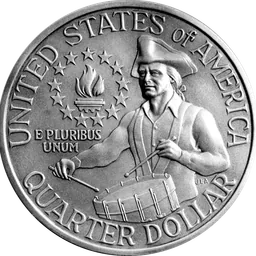
1976 values by mint mark
A coin with no mint mark was struck in Philadelphia.
| Coin | Mint | Mintage | Value |
|---|---|---|---|
| 1976 | Philadelphia, no letter | 809,784,016 | Face value |
| 1976-D | Denver | 860,118,839 | Face value |
Not sure which one you have? Scan it, and Coin Finder reads the mint mark for you.
Scan your coinHow to tell
This quarter was made for the Bicentennial. The front shows Washington, and the back shows a colonial drummer. Check your coin in this order:
- Look at the back. A colonial drummer means this is the Bicentennial quarter, not an ordinary Washington quarter such as the 1964 Washington quarter.
- Read the date. It shows two years, a double date. These quarters were minted in 1975 and 1976, but there are no quarters dated 1975.
- Find the mint mark. It is a small letter on the front, to the right of Washington's ponytail. A D means Denver. No letter means Philadelphia. An S means San Francisco.
The common coins and the collector sets
Philadelphia and Denver made these quarters in huge numbers, so neither coin is scarce, and a worn one from change is worth face value. It is a clad coin, a copper-nickel layer over a copper core, so there is no silver in a quarter from change.
The 1976-S was sold only in collector sets, and price guides do not list it here. Some of those coins contain silver. If you have one, it most likely came from a set someone bought, not from your change.
Errors and varieties
Price guides list no errors or varieties for this quarter. A coin that looks odd is usually worn, damaged or dirty rather than a rare find. If you think you have something unusual, a dealer or a professional grading service such as PCGS or NGC can look at it.
Condition
A worn coin is worth less than a clean, sharp one, but for this quarter the difference rarely matters to a person checking change. Do not clean your coin. Cleaning a coin lowers its value, and it leaves marks that a collector will notice.
Metal value
- $0.08 for copper-nickel clad copper (5.67 g)
Questions
Is a 1976 quarter worth keeping?
Most are worth 25 cents, so spending one is fine. Many people keep one as a souvenir of the Bicentennial, and that is a good reason to hold on to it.
Why does my quarter show two years in the date?
The double date marks the Bicentennial. The Mint used it, together with the drummer design, on quarters made in 1975 and 1976.
Did they make quarters dated 1975?
No. The Bicentennial quarters were minted in 1975 and 1976, but none are dated 1975.
Where can I see other quarters and coins?
See the 50 State Quarters for the next big quarter series, or browse every US coin guide.
More coins to check
Check the rest of your change
Over 1,100 US and UK coins by year and mint mark, each value with its source and the date it was checked.
